
About Beyond Cubicles
📢 #BeyondCubicles is a weekly LinkedIn series created by Carolina D’Souza, born out of her own experience transitioning from a corporate career to independent consulting. Since its launch in June 2024, the series has evolved into a platform that showcases the inspiring journeys of several founders who have redefined the traditional 9-to-5.
Through authentic narratives, #BeyondCubicles highlights themes of courage, resilience, and purpose. The stories feature individuals from diverse industries—ranging from tech and education to wellness and adventure—who share their experiences of stepping away from conventional roles to pursue passion-driven careers.
✨ Note: All features in this series are unpaid and shared as a way to honor and amplify real stories of transformation.
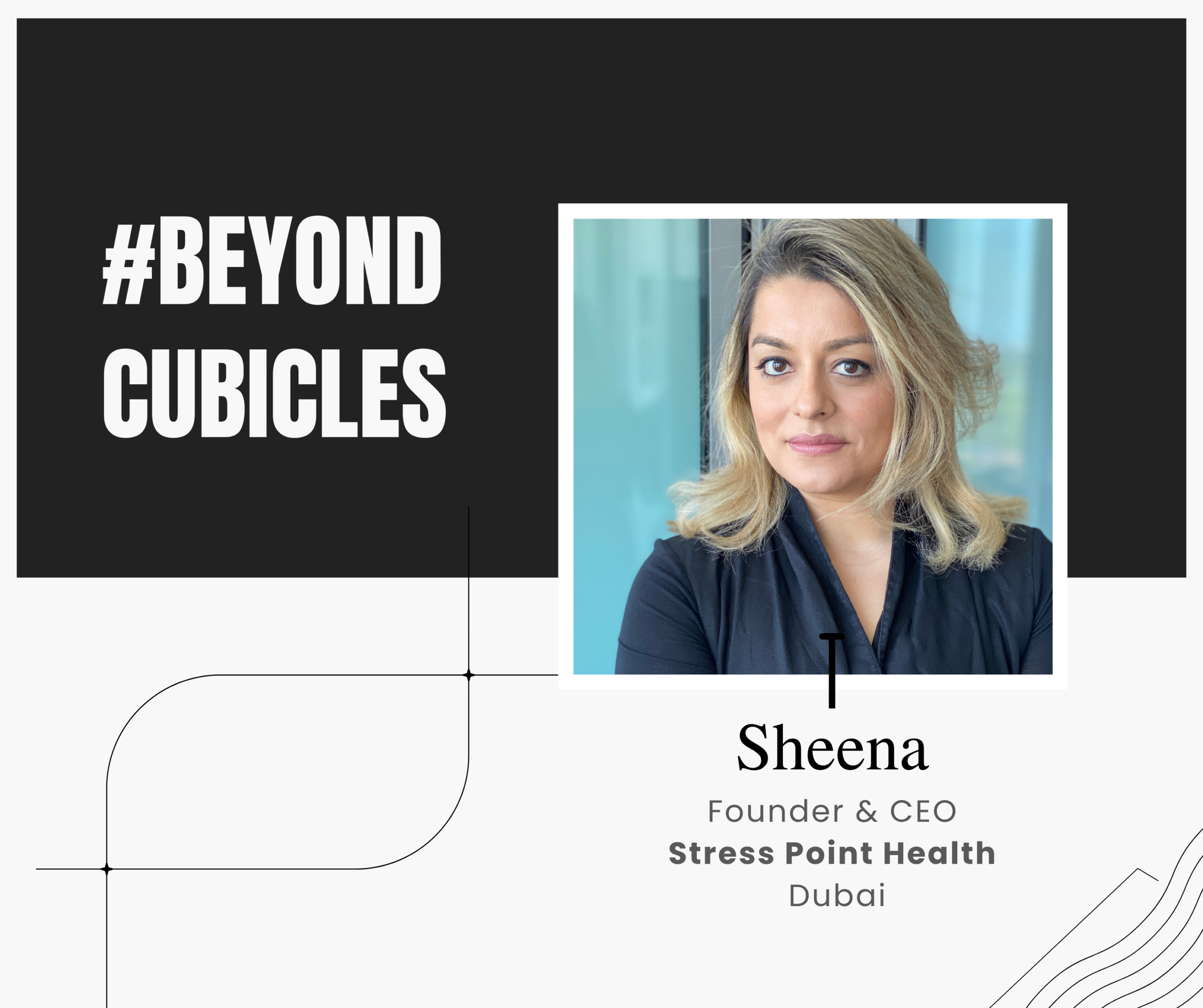
When Sheena Pirbhai worked in corporate finance, the environment was intense. She was also navigating PTSD following a road accident.
“It was clear, I wasn’t in the right place,” she says.
Years of recovery followed, including over 30 surgeries. She came to understand how deeply stress lives in the body and how little the world acknowledges it. It also sharpened her understanding of how unmanaged emotional responses undermine decision-making, leadership, and performance.
That perspective stayed.
After founding and exiting two companies between 2008 and 2019, she launched Stress Point Health in 2018.
“It wasn’t a pivot. It was the natural conclusion of everything I had experienced,” she says.
The company is built on a belief that emotional regulation sits at the foundation of mental health. “If the nervous system is dysregulated, insight alone doesn’t change behavior,” she says.
That conviction led to the development of a patented digital neurofeedback solution designed to regulate emotional responses in as little as 20 minutes. The technology is non-invasive, clinically validated, and already in use across corporates and healthcare systems.
The company name reflects the duality at the heart of the work. “It is the moment where the system begins to fracture, but it is also the point where intervention becomes possible,” she says.
Building something so closely tied to lived experience brought a different kind of challenge. “It wasn’t about building the company, but being seen building something this personal,” she says.
Doubt eased when she stopped separating the story from the work. Validation came through patterns. People began describing a state she recognized and finding a way through it.
Her personal brand shifted too, from founder-led to thesis-led. “Early on, I focused on telling my story. Over time, I have become much more direct about the point of view behind the work, that emotional regulation is the missing layer in mental health, and that it needs to be built into systems, not treated as an add-on.”
Originally from London and now based in Dubai, she describes fulfillment as congruence. “The work I do and the reason I do it are aligned.”
The region, she adds, offers something rare. “Instead of retrofitting legacy models, there is space to build systems that are more aligned with how people actually function.”