
About Beyond Cubicles
📢 #BeyondCubicles is a weekly LinkedIn series created by Carolina D’Souza, born out of her own experience transitioning from a corporate career to independent consulting. Since its launch in June 2024, the series has evolved into a platform that showcases the inspiring journeys of several founders who have redefined the traditional 9-to-5.
Through authentic narratives, #BeyondCubicles highlights themes of courage, resilience, and purpose. The stories feature individuals from diverse industries—ranging from tech and education to wellness and adventure—who share their experiences of stepping away from conventional roles to pursue passion-driven careers.
✨ Note: All features in this series are unpaid and shared as a way to honor and amplify real stories of transformation.
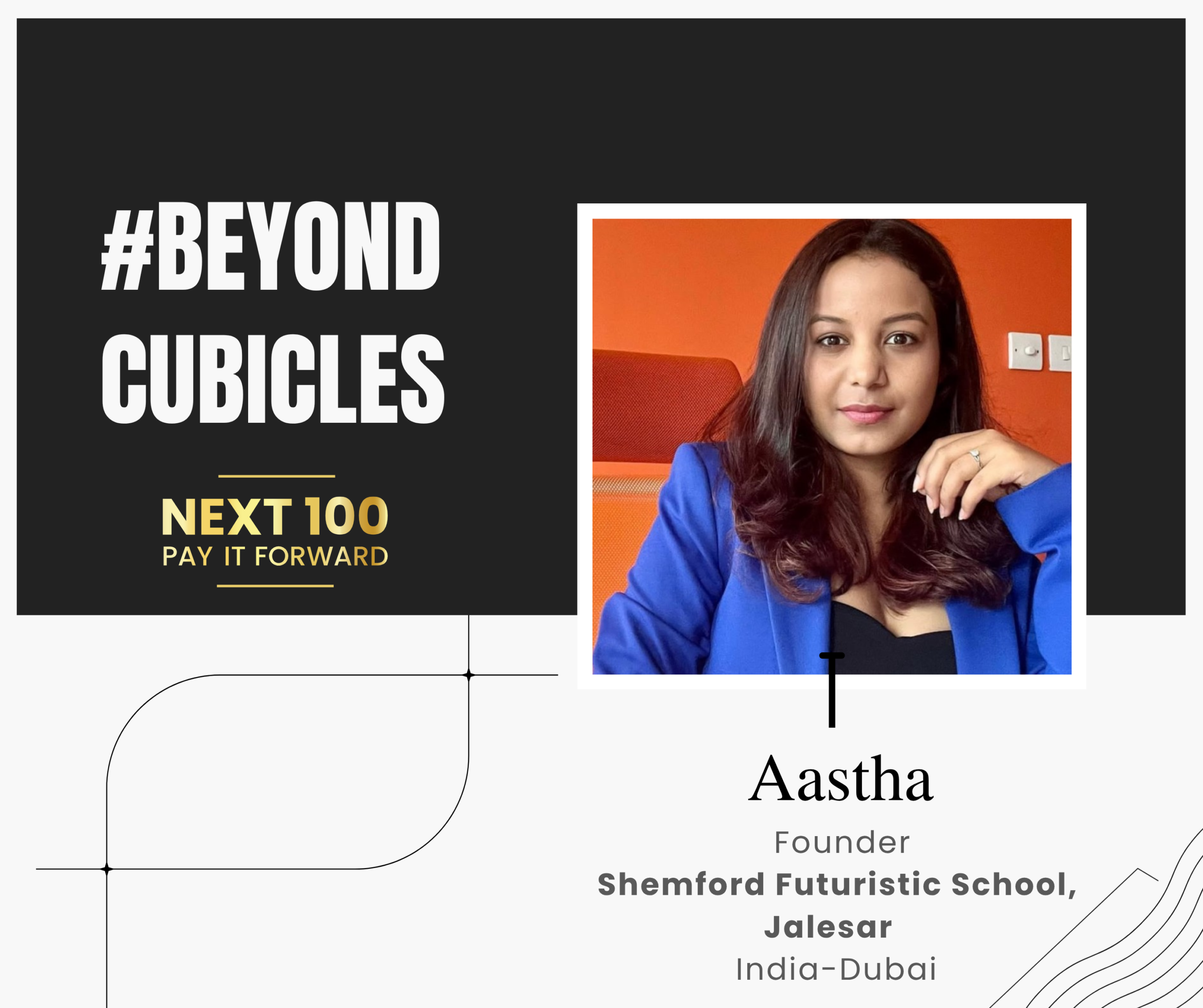
“We are not preparing children for the world that existed when textbooks were written. We are preparing them for the world that is already changing around them,” says Aastha Kanwar.
A career in digital strategy, marketing, and operations across India, the UAE, and the MENA region taught her how systems are built and scaled, shaping growth for brands including Amazon, Toshiba, and nearly 100 others.
The work that stayed went beyond brands. Time with Mentor Me India and the Indian National Youth Foundation brought her closer to a reality she could not ignore.
“Intelligence is distributed. Exposure is not,” she says.
Education was not abstract. Her mother-in-law has spent 35 years running a school, demonstrating what sustaining an institution requires.
She could see how systems are built, how education functions, and the gap between potential and access outside major cities. “If I did not step into that gap, I would keep building things that felt intelligent but not aligned,” she says.
That realization led to Shemford Futuristic School, Jalesar, Etah, a Tier 3 city in India. She describes it as “confidence architecture”, focused on communication, confidence, creative thinking, and expression without fear.
“The goal is not to urbanize children. The goal is to remove the dependency of opportunity on geography,” she says.
The transition cost certainty, predictability, and relationships that no longer survived. “It also cost time in ways not visible from the outside,” she says. “Emotions fluctuate, but systems do not,” she says.
The turning point was in defined moments: A child speaking confidently after remaining silent. A classroom becoming participative. Parents noticing their child thinking differently.
The journey removed overconfidence she did not know she had. “I stopped building a career. I started thinking of myself as someone who is responsible for a system,” she says.
Her personal brand shifted with it. “The perception changed faster than my own self definition,” she says.
Her husband and father-in-law, whom she describes as the backbone of the school’s operations, alongside her mother-in-law, parents, and grandparents, have been her foundation.
Aastha came to the UAE in 2021, later choosing to split her time between Dubai and India. “I never expected that building a school would feel less like construction and more like continuous correction of how children see themselves,” she says.